Email Automation for Founders: What to Automate and How
Which email tasks a founder can hand off to AI and which need a human: triage, drafts in your tone, follow-up tracking, scheduling, and labeling,…
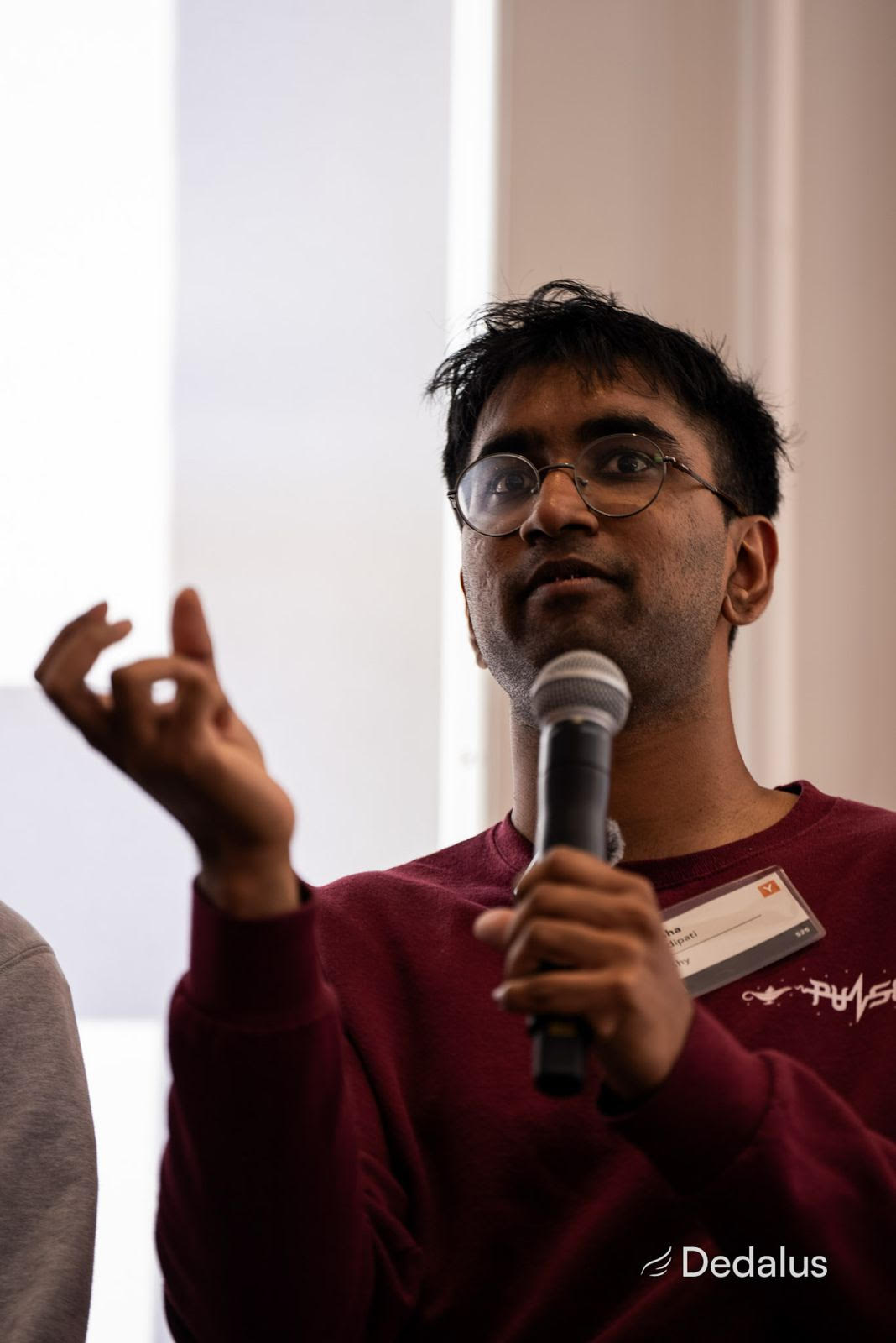
Harsha Gaddipati
May 21, 2026 · 11 min read
Founders should automate the rule-shaped inbox work first: triage into labels, follow-up tracking, scheduling and labeling. Drafts can be automated too if the tool learns your voice rather than filling a template, and the sensitive threads still get a human read. This guide walks through each task, how AI email automation works, and what is safe to hand off.

Most advice about founder email is about volume: how to survive 200 messages a day, how to reach inbox zero. That is a real problem, and it has its own guide in handling 200 emails a day as a founder. This piece is about a different lever. Instead of getting faster at doing the same manual work, a founder can stop doing the mechanical parts entirely and route them to AI. The hard question is not whether automation works, but where to draw the line. Sorting and first drafts are safe to automate. Deciding what to promise an investor is not. The sections below map exactly which tasks to hand off, how the handoff works, and where a human has to stay in the loop.
What email tasks should founders automate?
The tasks worth automating share one trait: they are repetitive, rule-shaped, and low-stakes to get slightly wrong on the first pass. The tasks to keep are the ones that require judgment, carry commitment, or depend on relationship context only the founder holds.
A useful way to sort them is by how much a mistake costs. Mislabeling a newsletter as "Other" costs nothing. Drafting a reply that needs one edit costs ten seconds. Promising a customer a refund you did not intend to costs trust. The first two are automation territory. The third is not.
Here is the practical split for a founder's inbox:
| Task | Automate it? | Why |
|---|---|---|
| Sorting inbound mail into categories | Yes | Rule-shaped, runs on every message, cheap to correct |
| First-draft replies to routine threads | Yes, with review | AI gets you 80% of the words; you approve or tweak |
| Tracking who has not replied yet | Yes | Pure bookkeeping a human forgets under load |
| Proposing meeting times | Yes | Calendar math is deterministic; you confirm the slot |
| Applying labels and snoozing threads | Yes | Mechanical, repeated dozens of times a day |
| Deciding terms, equity, or pricing | No | High commitment, needs the founder's intent |
| Sensitive or emotional conversations | No | Tone and judgment a model cannot own |
| The final send on anything that matters | No | A human should approve before it leaves |
The pattern: automate the sorting, the drafting, and the remembering. Keep the deciding and the committing. Founders who get this balance right report that they spend their inbox time on the few threads that genuinely need them, rather than on the busywork around those threads. That is the whole point of AI email for founders: not replacing the founder, but clearing the runway in front of them.
How does AI email automation work?
AI email automation runs as a layer over your inbox that reads incoming mail, classifies it, and prepares actions for you to approve. It does not require you to write rules or build filters. The system learns from what you do and adapts.
In an AI-native client like Slashy, the flow has four stages, and a founder touches only the last one.
First, triage. Every inbound message is classified the moment it arrives, into categories such as Important, Calendar, Billing, Newsletter, Order, Other, and Work. This happens before the founder opens the inbox, so the threads that move the company forward are already surfaced and the noise is already filed. There is a full breakdown in how Slashy triages email before you see it.
Second, drafting. For threads that need a reply, the system reads the context and writes a first draft in the founder's voice. This is where the memory system earns its keep: it has learned how the founder writes to investors versus how they write to their own team, and it shapes the draft accordingly.
Third, tracking. When the founder sends an email that needs a response, the system watches the thread. If the recipient goes quiet past the window where a reply was expected, it surfaces a reminder. If they reply, the reminder clears itself. This is the bookkeeping that humans drop first under load.
Fourth, review. The founder approves, edits, or ignores. Nothing important leaves the inbox without a human glance. The automation does the mechanical 90%; the founder owns the final 10% that carries the decision.
The reason this works without rules is that the system is built around a memory layer rather than a static filter set. The longer it runs, the better its triage and drafts get, because it is learning from corrections rather than waiting for the founder to configure it. That distinction, learning versus configuring, is the difference between AI-native and bolted-on email, covered in the AI email landscape.
Will automated replies sound like me?
This is the question founders ask first, and rightly so. A reply that does not sound like you is worse than no reply, because it signals you outsourced something personal. The answer depends entirely on how the tool generates the draft.
Generic "help me write" features produce competent, characterless prose. They do not know that you open with "Hey" to your team and "Hi" to investors, that you keep replies to three sentences, or that you never use exclamation points. A tool that has not learned your voice is guessing at it.
Slashy's drafts are generated from an in-house memory system that learns continuously from the email a founder sends, receives, and responds to. The measurable result is that AI-draft acceptance climbs from around 30% on day one to over 80% by day 30 as the system learns the founder's tone, recipients, and timing (source: Slashy product data on draft-acceptance rates). On day one, the drafts are a starting point and the founder edits most of them. By the end of the first month, most replies land in the founder's voice on the first pass and go out with one click.
"Founders remember who got back to them first. Now I'm always that person."
Priscilla Russo, Redpoint
The reason acceptance climbs rather than plateauing is that the system treats every edit as a signal. When a founder rewrites a draft, the memory agent learns from the change. A bolted-on feature that does not retain context cannot do this, which is why those features stay generic no matter how long you use them. There is a deeper write-up in AI email drafts that sound like you and on how AI learns your writing voice from sent emails.
Slashy prepares replies, remembers open loops, and keeps customer, investor, candidate, and team conversations on track.
What does this look like task by task?
The clearest way to see the payoff is to compare the manual version of each task with the automated version. The manual column is what most founders do today in plain Gmail. The automated column is what an AI-native client handles.
| Task | Manual today | Automated with Slashy |
|---|---|---|
| Triage | Scan every subject line, open anything that looks urgent | Mail is pre-sorted into seven labels before you open it |
| Replies | Read the thread, recall context, write from scratch | A draft in your tone is ready; you approve or edit |
| Follow-ups | Remember who owes you, set manual snoozes or labels | Reminders fire only when a recipient goes quiet |
| Open tracking | Guess whether they saw your email | See whether it was opened, on which device, how many times |
| Scheduling | Switch to the calendar, find a slot, type it out | Propose times from a sidebar without leaving the thread |
| Labeling | Tag threads by hand, one at a time | Labels applied automatically as mail arrives |
| Phone triage | Open the app, scroll, act | Clear urgent threads over iMessage between meetings |
The time saved per task is small. The aggregate is not. A founder who reclaims fifteen minutes a day from drafting alone gets back more than an hour a week, and the bigger gain is attention: the mechanical load no longer competes with the threads that need real thought. For the volume-specific version of this argument, see handling 200 emails a day as a founder.
There is also a compounding effect worth naming. Triage, drafting, and scheduling all draw on the same memory layer, so improving one improves the others. The system that has learned how a founder writes to a given investor also knows that investor is high priority for triage and proposes meeting times that fit the cadence of that relationship. A founder is not stitching together a labeling tool, a templates tool, and a scheduling tool that each know nothing about the others. One layer handles all of it, and it gets sharper across every task at once.
How do you automate follow-ups without dropping threads?
Follow-up tracking is the single highest-leverage thing a founder can automate, because it is the task humans fail at most reliably. You send an email, the recipient means to reply, and the thread sinks under everything that arrives after it. The deal you lose is rarely the one you said no to; it is the one you forgot to chase.
The manual systems work but lean on memory. Gmail Nudges resurfaces threads it guesses you forgot. Snooze brings a thread back on a chosen day. A "Waiting on" label gives you a pipeline view you scan once a day. All three are covered step by step in how to set up email follow-up reminders. Their shared weakness is that they fire whether or not the person replied, so you still have to check each thread by hand.
Automated follow-up tracking solves this with ghost detection. The system watches whether the recipient actually replied and only surfaces a reminder if they have gone silent. If they reply, the reminder clears itself, so resolved threads do not nag you and only genuine open loops surface. Open tracking adds a second signal: a reader who has not opened your email needs a different nudge than one who opened it three times and is sitting on a decision. When the reminder does fire, the follow-up is drafted in your tone, so the nudge sounds like you rather than a template.
This is the clearest example of the automation line. The system handles the remembering, the watching, and the first draft of the nudge. The founder decides whether this thread is worth a third touch or a switch to another channel. The bookkeeping is automated; the judgment stays human.
Is it safe to automate email?
Safety has two meanings here, and both matter to a founder. The first is data security: who can see your email and whether it trains someone's model. The second is operational safety: whether automation will send something you did not intend.
On data security, the requirements are concrete. Slashy maintains SOC 2 Type II and CASA Tier 2 compliance, encrypts data at rest and in transit, and none of the AI providers train models on user email data, with zero data retention from those providers. For a founder handling investor updates, hiring conversations, or customer contracts, that compliance stack is the baseline for letting an AI layer touch the inbox at all.
On operational safety, the design choice that matters is keeping a human on the send. Slashy drafts, sorts, tracks, and proposes, but the founder approves anything that leaves the inbox. Automation that sends on its own is where risk concentrates, because a wrong send to the wrong recipient cannot be recalled. By keeping the founder on the final action, the system captures the time savings of automation without handing over the commitment. The mechanical work is automated; the irreversible action is not.
That is the same line the whole post draws. Automate the parts where a mistake is cheap and reversible. Keep the parts where a mistake costs trust or cannot be undone.
A practical way to ease into this: turn on triage and follow-up tracking first, because both are reversible and require no trust in the model's writing. A mislabeled thread is a one-click fix, and a follow-up reminder that fires a day early costs nothing. Once a founder sees the sorting hold up over a week, AI drafting is the natural next step, reviewed at first and trusted more as acceptance climbs. The send stays manual throughout. That sequencing lets a founder adopt automation at the pace their confidence allows, rather than handing over the inbox on day one.
Visit Slashy
AI-native email and calendar client for founders and operators.
Frequently asked questions
Have more questions? Visit our Help Center.
Related reading
- How to set up email follow-up reminders
- How to write a follow-up email that gets a reply
- Handling 200 Emails a Day as a Founder
Connect Gmail or Outlook and see Slashy with your own email.

The Best Email Tools for Executive Assistants in 2026
What actually works for EAs managing an executive inbox: Gmail delegation limits, plus Front, Superhuman, Shortwave and Slashy. Prices checked September 2026.

Front Alternatives in 2026: Shared Inbox and AI Email Tools
Five Front alternatives on price, shared inboxes, ticketing and AI: Missive, Help Scout, Hiver, Slashy and Superhuman. Checked September 2026.

Best Email Client for a Google Workspace Team in 2026
Slashy, Gmail with Gemini, Superhuman, Shortwave, Missive and Hiver compared for Google Workspace teams on team features, SSO and price per seat.
Let your inbox do the follow through
Slashy drafts replies, tracks what is waiting, and keeps important conversations moving.